

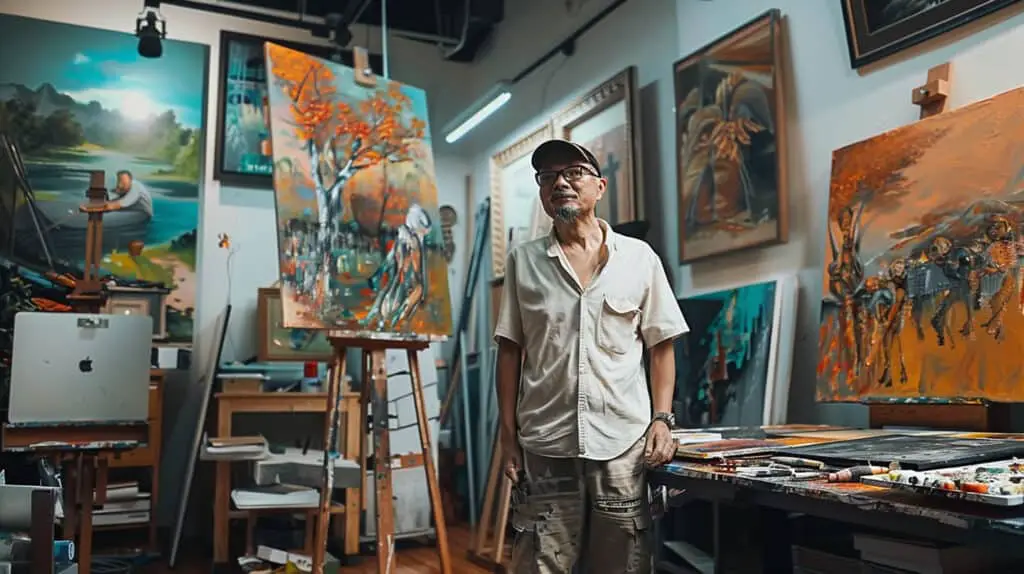

Ever wondered who the true legends of Malaysian art are? You’re not alone. Many art enthusiasts are eager to uncover the roots of Malaysia’s vibrant and diverse artistic heritage.
I had the chance to stand before one of Latiff Mohidin’s iconic pieces, and the layers of emotion and history it conveyed left a lasting impression.
In this article, we’ll introduce you to Malaysian painters, fun facts and more. Here are 6 most famous ones:
- Ahmad Syed Jamal
- Latiff Mohidin
- Cheng Haw-Chien
- Chang Fee Ming
- Yong Mun Sen
- Yusof Ghani
Each of these artists has left a bold mark on the art world with their unique techniques, striking styles, and profound cultural influence.
Keep reading to discover their masterpieces and gain a deeper appreciation for Malaysia’s rich visual arts legacy.


History and Overview of Argentine Painters

The history of Malaysian painting is deeply rooted in the country’s diverse cultural heritage, blending traditional Malay, Chinese, and Indian influences with Western artistic movements. In Kuala Lumpur, the rise of contemporary galleries has played a key role in showcasing this evolution.
Artists began their artistic careers with drawings and other forms of expression that explores the human condition, capturing the complexities of both personal and societal experiences. Over time, their works grew in sophistication, drawing inspiration from both local traditions and international art trends.
Major exhibitions and auctions, like those held by Henry Butcher Art Auctioneers, have helped elevate Malaysian artists’ global recognition. Today, Malaysian painters continue to explore new artistic territories, reflecting the country’s rich cultural diversity and history while engaging with contemporary issues.
According to the study “The Meaning and Themes of Malay Culture in Modern Paintings,” Malaysian artists like Abdul Latiff Mohidin, Cheng Haw-Chien, and Yusof Ghani integrate traditional Malay cultural symbols and themes into their modern artworks. The study found that these artists often blend local heritage with contemporary techniques, creating a unique visual language that reflects Malaysia’s diverse identity. This fusion of tradition and modernity parallels the way regional influences shape both the physical and artistic traits seen in Germany, as discussed in the article.
| Painter | Birth–Death | Era | Painting Style | Notable Works |
|---|---|---|---|---|
| Abdul Latiff Mohidin | 1938–Present | Modern | Abstract, Expressionism | “Pago-Pago” series, “Monsoon” series |
| Ismail Zain | 1946–2011 | Modern | Conceptual, Abstract | “Language of Space”, “Harmony in Space” |
| Syed Ahmad Jamal | 1930–Present | Modern/Contemporary | Abstract Expressionism, Mixed Media | “Urban Landscape”, “The Spirit of the Forest” |
| Khalil Ibrahim | 1934–2018 | Modern | Figurative, Expressionism | “Keris”, “Pahlawan” |
| Zulkifli Yusoff | 1962–Present | Contemporary | Contemporary, Mixed Media | “Reflection”, “The Observer” |
| Tan Chiew Tong | 1932–2014 | Contemporary | Realism, Landscape Painting | “Landscapes of Malaysia”, “Malaysian Villages” |
| Fazli Zainol | 1982–Present | Contemporary | Modern, Abstract | “Perception”, “Echo of Silence” |
| Norita Mohd Noh | 1972–Present | Contemporary | Mixed Media, Figurative | “Intricate Layers”, “Living in the Void” |
Top 6 Malaysian Artists
1. Ahmad Syed Jamal

Ahmad Syed Jamal (1930–Present) is a pioneering figure in the development of modern art in Malaysia. Known for his abstract and figurative works, Syed Jamal’s art bridges traditional Malaysian themes with modernist influences, drawing inspiration from both Southeast Asian and Western artistic movements. His work often explores the emotional and spiritual connection to his surroundings, with a focus on the natural world and its intricate details.
Syed Jamal trained at the prestigious Académie des Beaux-Arts in Paris, where he was introduced to European modernism, including the influence of French Impressionism and Post-Impressionism. His style blends elements of abstraction, geometry, and organic forms, often reflecting the environment and cultural heritage of Malaysia.
Fun facts:
- His use of batik as a medium in several works showcases the fusion of traditional Malaysian craft with modern artistic expression.
- Syed Jamal’s art frequently reflects his interest in nature, with many of his works inspired by the tropical landscapes of Malaysia.
- He was one of the founding members of the Malaysian Artists’ Association in the 1950s, helping to establish a collective of modern artists in Malaysia.
- His work was exhibited internationally, including in countries like France, the United States, and Japan, highlighting his global recognition.
- Syed Jamal was also an influential educator, mentoring a new generation of Malaysian artists, encouraging them to explore abstract forms and have contemporary art practices.


Famous works:
“The Eternal Dance” (1970s): An abstract exploration of motion and rhythm, symbolizing the dynamic and interconnected nature of life and spirituality.
“Batik Abstract” (1960s): A series that fused batik techniques with modern abstraction, showcasing the intersection of traditional Malaysian art and contemporary aesthetics.
2. Latiff Mohidin

Latiff Mohidin (1938–Present) is a celebrated Malaysian artist renowned for his bold, abstract works and his ability to merge Southeast Asian traditions with modernist Western styles. He is most famous for his “Pago-Pago” series, which explores the cultural and emotional connections between Southeast Asia and the South Pacific. His art captures the essence of landscapes, nature, and the human experience, often with a focus on movement and fluidity.
Latiff’s artistic journey began in Malaysia, but he later pursued studies at the University of Fine Arts in Berlin, where his exposure to European art movements like Expressionism and Surrealism deeply influenced his style. His work bridges the gap between traditional Malay symbolism and contemporary abstraction, making him one of the most important figures in Malaysian art.
Fun facts:
- Latiff’s “Pago-Pago” series was inspired by his travels to the South Pacific, particularly the islands of Pago-Pago, where he sought to depict the spiritual and cultural connection between the land and its people. He loved exploring places with rich cultural histories, and his travels continue to inspire his work.
- He once shared how his time in Berlin was transformative, pushing him to question his own artistic identity and merge Western abstraction with his roots in Southeast Asia.
- A fun personal tidbit: Latiff Mohidin is also an accomplished poet, and his love for literature often seeps into his work, with many of his paintings having poetic titles or being inspired by the written word.
- In the 1970s, Latiff spent several years in Europe, where he gained international recognition. He exhibited in prominent galleries in Paris, New York, and Singapore, earning accolades for his unique fusion of cultures.
- His deep connection to the Malaysian rainforest is evident in his works, as he often painted landscapes inspired by the lush forests and rich biodiversity of his homeland.


Famous works:
- “Pago-Pago” (1960s): A pioneering series that uses abstract forms and vibrant colors to reflect the spiritual and cultural link between the islands of the South Pacific and Southeast Asia.
- “Monsoon” (1970s): A striking series that captures the raw energy and beauty of the monsoon season, often depicting the fierce rains and the dramatic transformation of nature during this time.
- “Landscape of the Soul” (1980s): A deeply reflective work that combines abstract forms with natural landscapes, showcasing the artist’s inner dialogue with nature and the environment.
Latiff Mohidin’s work continues to inspire and engage new generations of artists and art lovers alike, with his ability to blend cultural heritage and modernism setting him apart as a true visionary.
3. Cheng Haw-Chien

Cheng Haw-Chien (1949–Present) is a renowned Malaysian artist known for his striking, vibrant works that blend traditional Chinese art with modernist influences. His unique approach combines abstract expressionism and realism, creating art that resonates deeply with both cultural heritage and contemporary aesthetics. Cheng’s ability to capture the essence of Malaysian life through rich color palettes and dynamic brushstrokes has made him one of Malaysia’s most celebrated painters.
Trained in both Malaysia and Taiwan, Cheng’s early works were influenced by Chinese ink painting techniques, but he later incorporated Western styles, reflecting his global exposure. His art often focuses on landscapes, portraits, and cultural identity, which reflect both his personal experiences and the changing socio-political landscape of Malaysia.
Fun facts:
- Cheng was greatly inspired by his travels through China, Taiwan, and Southeast Asia, absorbing the diverse cultural nuances that would later influence his artwork.
- A personal touch: Cheng once revealed that he enjoys meditative painting — often using the act of creating art as a form of self-reflection and spiritual connection, making his process as meaningful as the final piece.
- His work in calligraphy also plays a significant role in his artistic style. Cheng often incorporates traditional Chinese characters into his paintings, blending text and image in an expressive, abstract manner.
- Cheng’s dedication to his craft has earned him a reputation for being a “painter of peace”, with many of his works reflecting themes of harmony, balance, and unity.
- Despite his international success, Cheng remains deeply connected to his Malaysian roots. His works continue to explore themes of identity and heritage, especially in the context of Malaysia’s multicultural society.

Famous works:
- “Spring Awakening” (1990s): A vibrant piece symbolizing renewal and the harmony of nature, blending traditional Chinese brushwork with contemporary abstraction.
- “Unity in Diversity” (2000s): A powerful representation of Malaysia’s multicultural society, where different cultural elements are woven together in a visually stunning, harmonious composition.
- “Journey of the Soul” (2010s): A deeply introspective work that reflects Cheng’s own spiritual journey, using fluid brushstrokes and vivid colors to express the depth of personal experience and cultural exploration.
Cheng Haw-Chien’s work continues to push the boundaries of modern Chinese art in Malaysia, blending cultural influences with his personal experiences to create deeply engaging, thought-provoking pieces.

4. Chang Fee Ming

Chang Fee Ming (1959–Present) is one of Malaysia’s most prominent and celebrated watercolor artists, widely recognized for his ability to capture the beauty of urban and rural landscapes with intricate detail.
His work has taken him across the world, from Southeast Asia to the Middle East and Europe, where he has drawn inspiration from the cultures, architecture, and natural environments he encounters. Chang is best known for his evocative portrayals of local life, architecture, and nature, which often showcase his mastery of both realism and expressive watercolor techniques.
Chang studied at the University of Malaya in Kuala Lumpur, where he earned his degree in Fine Arts. His early exposure to traditional Chinese watercolor techniques was further honed during his study trips to China and other parts of Asia.
His travels have greatly influenced his work, with his pieces being featured in numerous solo exhibitions and galleries internationally, including in New York, Singapore, and Hong Kong. Chang’s works are also a regular feature in prestigious institutions like the National Art Gallery of Malaysia, and his pieces have been displayed in art museums and private collections around the world.
Fun facts:
- Chang’s international travels are a core influence on his art, particularly his journey through India, where he developed a deep appreciation for the vibrant colors and spiritual architecture of the region.
- His dedication to detail is legendary. Chang has been known to spend weeks capturing the smallest nuances of light, texture, and shadow in his landscapes, creating a sense of life and movement in his watercolor works.
- He has received numerous awards for his contributions to the field of art, including accolades from the Malaysia Watercolour Society and other renowned cultural institutions.
- Chang’s work is often compared to classical Chinese brush painting, but with a modern perspective that blends realism with elements of abstraction, a reflection of his deep understanding of both Eastern and Western artistic traditions.

Famous works:
- “Cityscape of Kuala Lumpur” (1990s): A stunning portrayal of the KL skyline, showcasing his skill at capturing both the grandeur and intricate details of the city’s architecture.
- “The Fisherman’s Village” (2000s): A beautifully detailed depiction of a rural Malaysian fishing village, highlighting the simplicity and richness of daily life by the sea.
- “Reflections of an Ancient Temple” (2010s): A meditative piece reflecting Chang’s travels in India, capturing the tranquil yet powerful presence of ancient architecture.
Chang Fee Ming’s art continues to leave an indelible mark on the global art scene. His ability to weave personal experiences, cultural influences, and technical mastery into every piece makes him a unique and influential figure in the world of contemporary watercolor painting.
See Also Malaysian Folk Art
5. Yong Mun Sen

Yong Mun Sen (1907–1962) is regarded as one of Malaysia’s most influential pioneers of modern art, particularly known for his landscape and portrait paintings. His early training at the Penang Art School and further studies in China exposed him to both Western and Eastern artistic traditions.
Yong is best known for his depiction of Southeast Asian scenes, often highlighting the beauty of rural life, fishing villages, and the natural environment of Malaysia. His work bridged the gap between realism and impressionism, capturing the essence of Malaysian landscapes with a deep sense of cultural identity.
Fun facts:
- Yong was a key member of the Penang Art Society, contributing greatly to the development of modern art in Malaysia.
- His landscape paintings often depicted the Tropical Rainforests of Malaysia, showcasing his love for nature and the environment.
- A respected educator, he mentored many aspiring artists, helping shape the local art scene in Penang.

Famous works:
- “Tropical Rainforest” (1940s): A vibrant depiction of Malaysia’s lush landscapes and flora.
- “The Fisherman” (1930s): A poignant portrayal of local fishing life in Penang.
See Also Traditional Malaysian Clothing
6. Yusof Ghani

Yusof Ghani (1950–Present) is one of Malaysia’s most celebrated contemporary artists, known for his innovative approach to abstract expressionism. His work blends elements of Malay culture, modernism, and social commentary, often exploring the themes of identity, struggle, and transformation.
Yusof’s artistic journey began at the School of Art, University of the Philippines, followed by studies at the St. Martin’s School of Art in London. His most iconic series, “Topeng” (Masks), delves into the complex layers of identity and society, using vibrant colors and dynamic forms.
Yusof’s work has been exhibited internationally, including in New York, London, and Singapore, and is featured in major collections such as the National Art Gallery of Malaysia. He is known for his bold brushstrokes and vivid colors, which express his deep engagement with Malaysian and global issues.
Fun facts:
- Yusof Ghani’s “Topeng” series is inspired by traditional Malay masks and explores themes of hidden identity and social facades.
- He is deeply influenced by Asian spirituality and the concept of self-transformation, which is reflected in the intense emotional energy of his work.
- Yusof is also an advocate for art education, frequently mentoring younger artists and giving back to the community through workshops and lectures.


Famous works:
- “Topeng” (1980s–Present): A series that focuses on the themes of masks and identity, blending abstract and figurative elements.
- “Migration” (1990s): A painting reflecting the movement of people and cultural exchange, symbolizing change and transformation.
Yusof Ghani’s work continues to resonate deeply with art lovers and collectors worldwide, as he pushes the boundaries of contemporary art while staying rooted in his cultural heritage.

According to the study “Painting Styles of Malaysian Chinese Artists in the 1960s under the Influence of Abstract Expressionism,” the research explores how Malaysian Chinese artists, influenced by Abstract Expressionism, merged Malaysian culture with Western artistic movements. This fusion led to a unique Malaysian modernist style, blending local cultural themes with global artistic trends.
Famous Malaysian Painters: A Recap
Malaysian art is a captivating fusion of heritage, modernism, and cultural expression. Artists like Yusof Ghani, Chang Fee Ming, and Latiff Mohidin have shaped Malaysia’s art scene by blending traditional Malaysian themes with contemporary techniques, creating visually powerful pieces that reflect the country’s dynamic identity.
These artists draw from their unique backgrounds, whether it’s Southeast Asian landscapes or the human condition, offering a deep, emotional connection to their work. I had the privilege of viewing Latiff Mohidin’s abstract pieces in an exhibition, and the way his work expressed the soul of Southeast Asia left a lasting impression.
Malaysia’s artists continue to push boundaries, enriching the global art landscape with their vibrant and diverse perspectives, showcasing the country’s rich cultural legacy.